
Discontinuity (Holiday) Testing
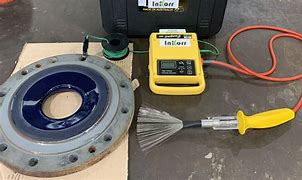 Discontinuity (holiday) testing, or “spark testing,” is a non-destructive testing method specified by the American Society for Testing and Materials (ASTM) in a number of recommended practices including ASTM D 4787 and ASTM D 5162. Of these two standards, ASTM D 5162, “Standard Practice for Discontinuity (Holiday) Testing of Nonconductive Protective Coating on Metallic Substrates,” has generally had greater applicability to the evaluation of pressure vessels and tanks in the chemical and petrochemical industry. ASTM D 4787 (“Standard Practice for Continuity Verification of Liquid or Sheet Linings Applied to Concrete Substrates”) applies to protective coatings for concrete surfaces. The National Association of Corrosion Engineers (NACE) is another source of standards for discontinuity testing, including NACE RPO 188-99 (“Discontinuity (Holiday) Testing of New Protective Coatings on Conductive Substrates”). Discontinuity (holiday) testing is considered to be a “surface testing method,” that uses an electric current in a circuit to field-identify discontinuities or voids in protective coatings such as glass, epoxy and other materials. Protective coatings or liners may be applied to the surface of the substrate to prevent aggressive chemical attack, or erosion / corrosion due to environmental or process conditions. Voids such as pin holes and cracks, or uneven application of the coating that results in very thin areas that may be less than the protective coating specification can lead to severe damage of substrates such as carbon steel. The performance of discontinuity testing with appropriately qualified instruments will result in a visible spark, and/or a [dramatic] change in instrumented voltage / alarm when a void or thinned area is identified. Discontinuity (holiday) testing can be separated into two categories: 1) low-voltage testing (wet sponge method) for protective coatings of 20 mils (0.5 mm) or less, and 2) high-voltage testing (brush/electrode method) for protective coatings greater than 20 mils (0.5 mm). NOTE: high-voltage testing per ASTM D 5162, Table 1, covers protective coatings from 0.2 mm to 6.5 mm (approximately 0.008” to 0.250”). Discontinuity testing may be performed after a protective coating has been applied and cured prior to service (QA) and/or may also be performed at regular intervals after service initiation to assure continued integrity of the protective coating.
Reliability Inspections, LLC (RI) is qualified to perform Discontinuity Testing on most materials. We can provide instruments for both low-voltage and high-voltage methods, and with advanced notice may acquire instruments for testing of protective coatings on concrete surfaces. We can help you determine which testing method and what types of testing equipment may be best for your application. We are also qualified to evaluate and interpret testing results to applicable and appropriate design and construction codes for given applications. RI employs a number of NDT Level II’s and III’s who are trained and qualified to operate the instruments and perform the analysis to code or customer specified standards. Our ASNT Level IIIs can write procedures and provide testing, qualification and support for owner/user in-house Discontinuity Testing programs. Our Level II technicians can perform Discontinuity Testing at the owner/user’s facility (ongoing maintenance or repair), or at field locations / fabrication shops where protective coatings are installed/applied. We can provide Discontinuity Testing services for most coating and substrate applications in a cost effective and efficient manner for customers who have equipment for which quality control of protective coating applications is essential to continued safe and reliable operation.